

Corporate Weirdness
THE ORBITAL HEIST: How Private Space Companies Seized Earth's Economy Through Secret Contracts and Hidden Assets
Audio edition
The government built the launch economy, then rewrote the rules so private contractors could own the upside, bill the public, and call it competition.
No cloak-and-dagger mythology is needed here. No secret moon lodge. No lizard congress. No orbital skull ring.
You can do this one with contracts, executive orders, appropriations tables, watchdog reports, and the official biography of the man put in charge of NASA. That is the part that should bother you. The paperwork is doing the screaming.
The simplest version is this: one private company became the center of American human spaceflight, the administration pre-deregulated the industry it dominates, and the agency most exposed to that industry got an administrator who was already a documented customer of that same company. That is not fringe. That is sequence.
The timeline
NASA picks one lunar-landing winner
NASA awards the Human Landing System contract to SpaceX alone, $2.89 billion, under PIID `80MSFC20C0034`, despite congressional pressure for two providers.
GAO kills the protest
Blue Origin and Dynetics lose at GAO. The sole-source structure survives the first serious challenge.
The court upholds the award
The Court of Federal Claims sides with the government. The procurement fight dies on narrow review grounds.
Option B, same company
NASA modifies the same SpaceX contract for another $1.15 billion and a second crewed landing, without re-opening competition.
A second provider appears later
Blue Origin gets a $3.4 billion Artemis V award, two years after NASA said the second provider Congress wanted was unaffordable.
Isaacman gets tapped for NASA
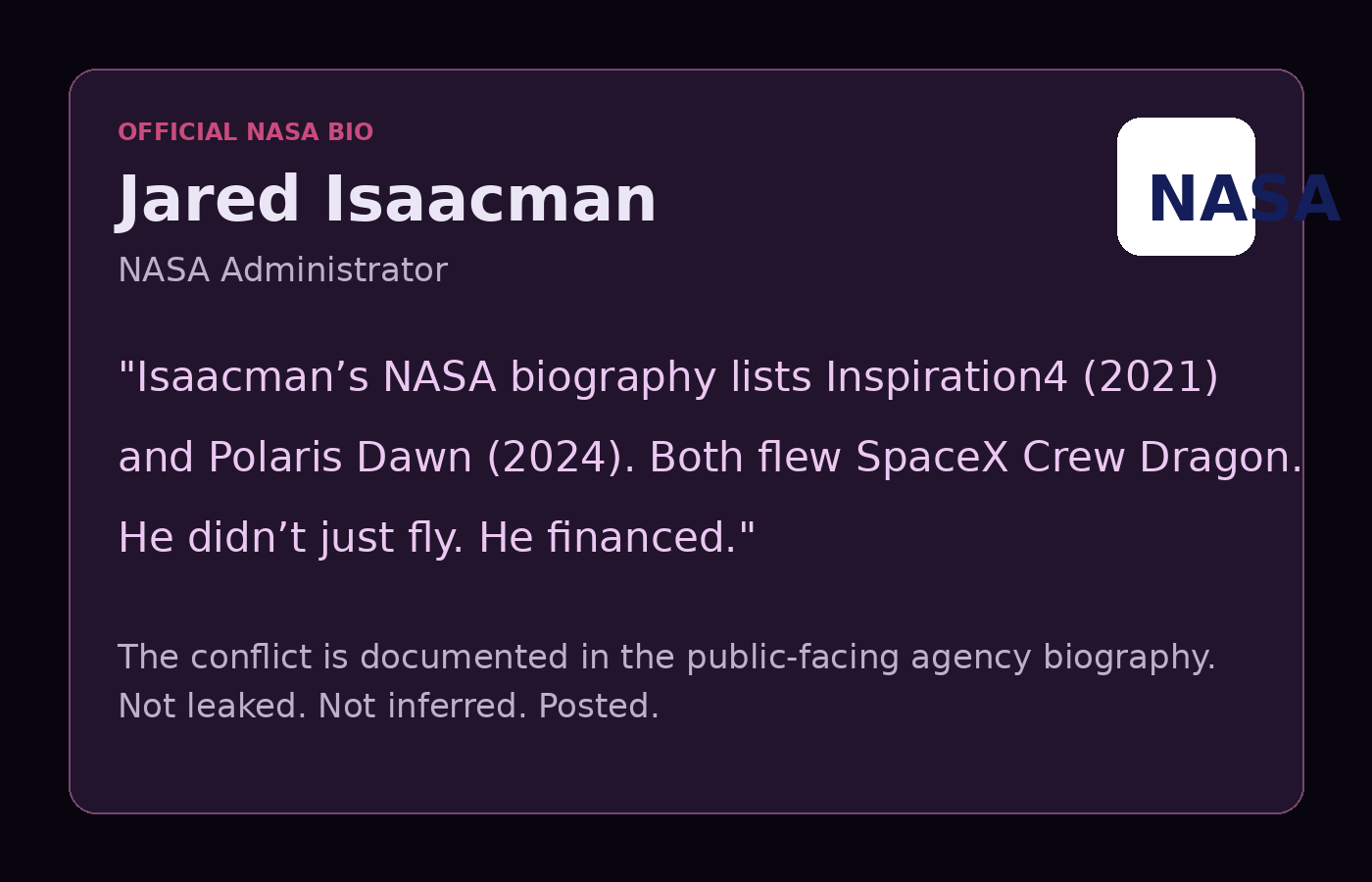
Trump names Jared Isaacman, a billionaire who paid SpaceX to fly him twice, as NASA Administrator before even taking office.
The classified-launch money lands
Space Systems Command awards $13.7 billion in classified-payload launch contracts, with SpaceX taking the largest share.
EO 14335 pre-clears the runway
Trump orders DOT to eliminate or accelerate launch-related environmental reviews and pushes agencies toward faster commercial space approvals.
Congress has to rescue NASA's topline
House Appropriations rejects the White House plan to cut NASA by 24.3 percent and holds the agency around $24.8 billion.
Confirmation, swearing-in, schedule lock
Isaacman is confirmed, sworn in, and the administration locks NASA to a 2028 lunar landing on a Starship architecture that still has not demonstrated its hardest mission steps.
The Inspector General says the quiet part loudly
NASA OIG report `IG-26-004` projects HLS at $18.3 billion through FY2030 and notes the agency granted providers significant latitude with reduced required reviews.
What happened
The commercial space sector took 78 percent of a $613 billion global industry in 2024. Then the administration issued an executive order designed to make launch approvals easier, faster, and harder for states to obstruct. Then the agency most entangled with those contractors got a new administrator whose official biography openly lists the SpaceX missions he paid to fly.
That is the sequence. That is the machine.

The weirdness is not that private firms participate in spaceflight. That has been the policy direction for years. The weirdness is the degree of consolidation, the softness of the oversight, and the speed with which public infrastructure got translated into private leverage.
NASA did not merely buy rides. It helped build the ecosystem, funded the capability, provided the proving ground, and then kept accepting contract modifications after the original competition was already over. That matters. If the public financed the risk and the contractor keeps the upside, you do not have a free market miracle. You have a transfer.
Why this matters
There is only one working American system for routine human orbital transport right now, and a private company owns it. That was supposed to be the situation Commercial Crew was designed to avoid. The whole pitch was redundancy. Then Starliner stumbled badly enough that NASA had to fall back on Dragon anyway. The backup became the incumbent, and the redundancy started looking decorative.
The Artemis landing architecture leans on Starship HLS, which still has to prove multiple tanker launches, orbital cryogenic propellant transfer, and the kind of operational reliability you would normally want before building a national deadline around it. The date kept slipping. The modifications kept flowing. And nobody with real power stopped the conveyor belt.
The Pentagon side is somehow even uglier. Phase 3 Lane 2 is sold as assured access to space, but assured access now means routing the nation’s most sensitive payloads through a tiny cluster of private launch operators, with the largest share going to the same company already sitting in the center of NASA’s human spaceflight stack. If you wanted concentration risk with patriotic packaging, congratulations, the invoice cleared.
What the record shows
- Executive Order 14335, at
90 Fed. Reg. 40219, instructs DOT to eliminate or accelerate launch-related reviews not required by law and pushes agencies toward faster commercial-space approvals. - USAspending.gov, for contract
80MSFC20C0034, shows the obligated value running well above the original $2.89 billion base, because the money stack grew through modifications rather than a new competition. - The FY26 CJS appropriations fight shows the administration first tried to slash NASA by 24.3 percent, then Congress had to block it.
- The Senate confirmation record shows Isaacman confirmed 67 to 30 on December 17, 2025, then sworn in the next day.
- NASA FOIA logs for FY2025 Q3 document steady correspondence between headquarters and major contractors while the actual contents remain largely buried behind exemption codes.
- NASA OIG report
IG-26-004says $6.9 billion was already obligated on HLS and projected the program at $18.3 billion through FY2030, while also noting reduced agency-required reviews.
This is the important hinge. The story is not only that the money is big. The story is that the oversight keeps getting lighter as the dependency gets deeper. That is backwards. That is the opposite of what a rational public-sector relationship with a dominant contractor should look like.
Why this changes everything
The public built the industrial base. The private sector kept the receipts.
That is what the Space Act Agreement logic does when left unattended for long enough. Facilities, expertise, testing environments, and in some cases direct support move through the public side. When the hardware matures, the intellectual property largely sits with the private partner. The reporting exists, yes, but reporting is not oversight. A quarterly update posted to a website is not a substitute for adversarial review. It is filing.
If the state pays to cultivate the launch ecosystem, relies on the launch ecosystem, deregulates the launch ecosystem, appoints a customer of the launch ecosystem to run the civil space agency, and then continues piling money into the same dominant vendors, the argument is no longer about public-private partnership. The argument is about capture.
And once you look at it that way, the sequence stops looking accidental. Not because there is a secret cabal around a polished lunar table, but because concentrated industries do exactly this when nobody stops them. They turn access into dependence. They turn dependence into leverage. They turn leverage into policy. Then they call the result innovation.
The pattern hardens
The numbers are getting larger while the asset classes are getting weirder. The Space Foundation’s own framing is already pushing the global space economy toward the trillion-dollar threshold. Private market research is pricing in orbital habitats, lunar industry, servicing rights, and resource extraction categories that barely exist as real markets yet. The speculation is speculative, yes. But the direction of travel is not. Everybody serious in the industry is pricing in private control over future space infrastructure.
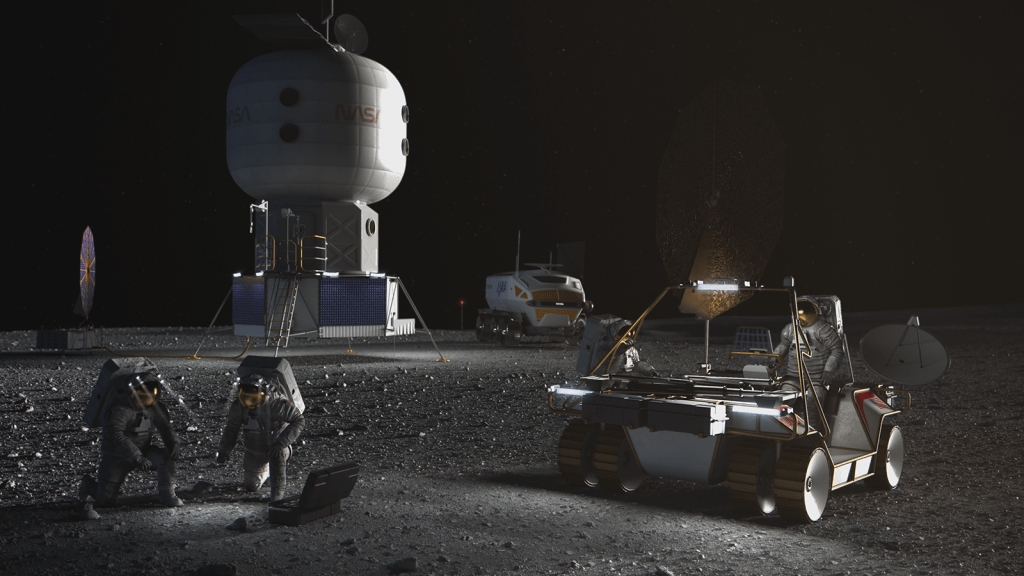
The law is part of the opening. The Outer Space Treaty blocks national appropriation of celestial bodies, but it does not cleanly resolve the corporate version. The 2015 Commercial Space Launch Competitiveness Act gives U.S. firms rights to extracted resources. That gap is not a clerical issue. That gap is the business model.
So when the administration orders a mission-authorization framework for novel space activities, do not hear only harmless bureaucratic mush. Hear the setup. Hear the floor being poured under an industry that wants its future property rights ready before the assets even physically exist. That is not science fiction. That is pre-positioning.
What survived
The documents survived. The contract number survived. The appropriations fight survived. The confirmation vote survived. The Inspector General report survived. The NASA biography survived. The FOIA log survived. The executive order survived. The board rosters survived.
That is why this piece does not need a conspiracy theory. It only needs the stamina to read the public record in order.
What adds up is ugly enough on its own:
- the commercial sector dominates a $613 billion space economy
- the government that built the ecosystem is now the smaller side of it
- the administration accelerated the regulatory process under a highly concentrated market
- NASA’s administrator is a documented paying customer of the dominant launch firm
- the same dominant contractor holds one of NASA’s largest single-vendor awards and the largest share of the newest classified-launch distribution
- the agency’s own watchdog says the reviews are light and the latitude is wide
They did not hide it. They normalized it. The heist is not orbital because it happened in secret. The heist is orbital because public infrastructure got lofted into private control while the paperwork kept calling it progress.
Sources
- Executive Order 14335, Enabling Competition in the Commercial Space Industry, 90 Fed. Reg. 40219 (Aug. 19, 2025)
- NASA Office of Inspector General, Report
IG-26-004, NASA’s Management of the Human Landing System Contracts (March 2026) - USAspending.gov, contract award PIID
80MSFC20C0034 - U.S. Space Force Space Systems Command, NSSL Phase 3 Lane 2 award announcement (April 4, 2025)
- NASA, NextSTEP-2 Appendix H Source Selection Statement (April 16, 2021)
- NASA, HLS Option B contract modification announcement (November 15, 2022)
- GAO decision, Blue Origin Federation, LLC; Dynetics, Inc.-A Leidos Company (July 30, 2021)
- U.S. Court of Federal Claims, Blue Origin Federation, LLC v. United States (Nov. 4, 2021)
- NASA news release on Blue Origin’s $3.4 billion sustaining lunar development award (May 19, 2023)
- Senate confirmation vote on Jared Isaacman, 67 to 30 (Dec. 17, 2025)
- NASA, Jared Isaacman official biography
- House Appropriations Committee, FY26 Commerce-Justice-Science Appropriations Act,
H.R. 5342 - Space Foundation, The Space Report 2025 Q2 (July 22, 2025)
- Space Foundation leadership and board page
- NASA Transition Authorization Act of 2017, Public Law 115-10, Section 841
- NASA FOIA Log FY2025 Q3
- Outer Space Treaty of 1967, Article II
- U.S. Commercial Space Launch Competitiveness Act of 2015, Title IV
- DataIntelo, Orbital Real Estate Market Report, cited only as speculative market context