
Disclosure Theater
THE BILL THAT WOULD HAVE FORCED LOCKHEED TO HAND OVER THE ALIENS — AND THE NIGHT IT DIED
Audio edition
Chuck Schumer helped introduce a bill that would have let the federal government seize non-human technology from private contractors, then the Pentagon arrived with a 33-page rewrite and cut its throat.
The weirdest part of the UAP story is not the aliens. It is the legal drafting.
In July 2023, the Senate Majority Leader of the United States helped introduce language that would have allowed the federal government to seize, by eminent domain, “recovered technologies of unknown origin and biological evidence of non-human intelligence” from private hands. That is not a Reddit summary. That is a Senate amendment.
Then, in November, the Pentagon walked into the room with a 33-page rewrite. By December, the teeth were gone. The bill survived in name, but the part that mattered, the part that could actually pry the vault open, died in conference like a man politely smothered with parliamentary velvet.
And no, the bill did not say Lockheed by name. It said private persons and entities. But if your brain instantly filled in the silhouette of a giant defense contractor anyway, welcome to the part of the movie where everyone pretends not to recognize the monster because it is wearing a badge.
The timeline
Project Sign begins at Wright-Patterson
The Air Force opens one of its earliest formal UFO investigations at the same base later tied, in lore and in filing-cabinet gravity, to recovered material stories.
Project Blue Book is officially terminated
The Air Force declares the UFO problem solved, which in Washington usually means the public-facing folder gets closed while the interesting folder learns how to whisper.
The Majestic-12 papers hit two FBI offices
The Bureau calls the documents bogus, then never pursues the alleged forger, which is a funny way to behave if the government truly thought someone had forged a memo naming a fantasy cabal of real national-security elites.
Project 1794 is declassified
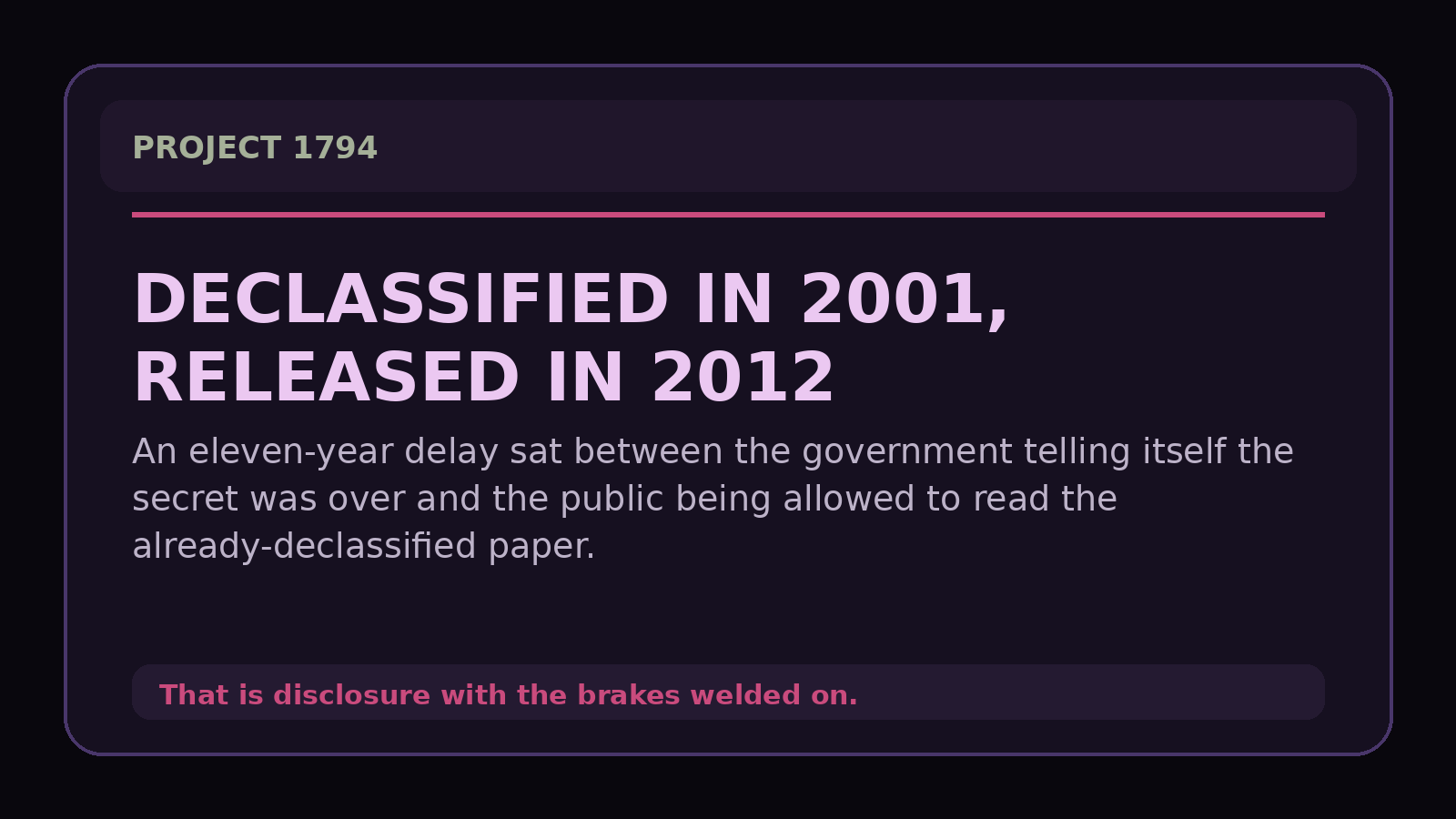
The Air Force formally declassifies records on a saucer-shaped aircraft concept designed for Mach 4 and a 100,000-foot ceiling, because history is a prankster with access badges.
Project 1794 finally reaches the public
Eleven years pass between declassification and public release, which is less disclosure than a very slow drip-feed conducted by a bureaucracy with trust issues.
The New York Times reveals AATIP
The Pentagon's years of no-such-program theater suddenly look shabby after the paper trail shows a real UAP study existed under Harry Reid's protection.
Schumer-Rounds introduces the UAP Disclosure Act
Senate Amendment 797 lands with the clause everyone remembers and almost nobody can believe is real: eminent domain over unknown recovered technology and non-human biological evidence held by private entities.
David Grusch testifies under oath
The former intelligence official tells Congress a multi-decade crash-retrieval and reverse-engineering program exists and says non-human biologics were recovered with craft.
The Pentagon submits a 33-page rewrite
The independent review board gets mauled, the eminent-domain muscle gets stripped down, and the bill's ability to force anything out of private custody starts bleeding out on the conference-room carpet.
The gutted NDAA becomes law
The shell survives. The knife does not. What passes is archival process without enough leverage to kick down the contractor door everyone was suddenly pretending not to see.
The National Declassification Center dumps 4,077,991 pages
A paper mountain arrives, proving once again that in America truth is often technically available, just buried under enough cellulose to count as geological concealment.
Elizondo testifies and Immaculate Constellation enters the record
The former AATIP official says we are not alone, Shellenberger's report gets entered into the Congressional Record, the Pentagon denies it, and the denial begins to sound less like closure than muscle memory.
What happened
The Senate Majority Leader of the United States tried to write a law that could take the alleged alien stash back from private contractors. That is the simple version. The true version is worse.
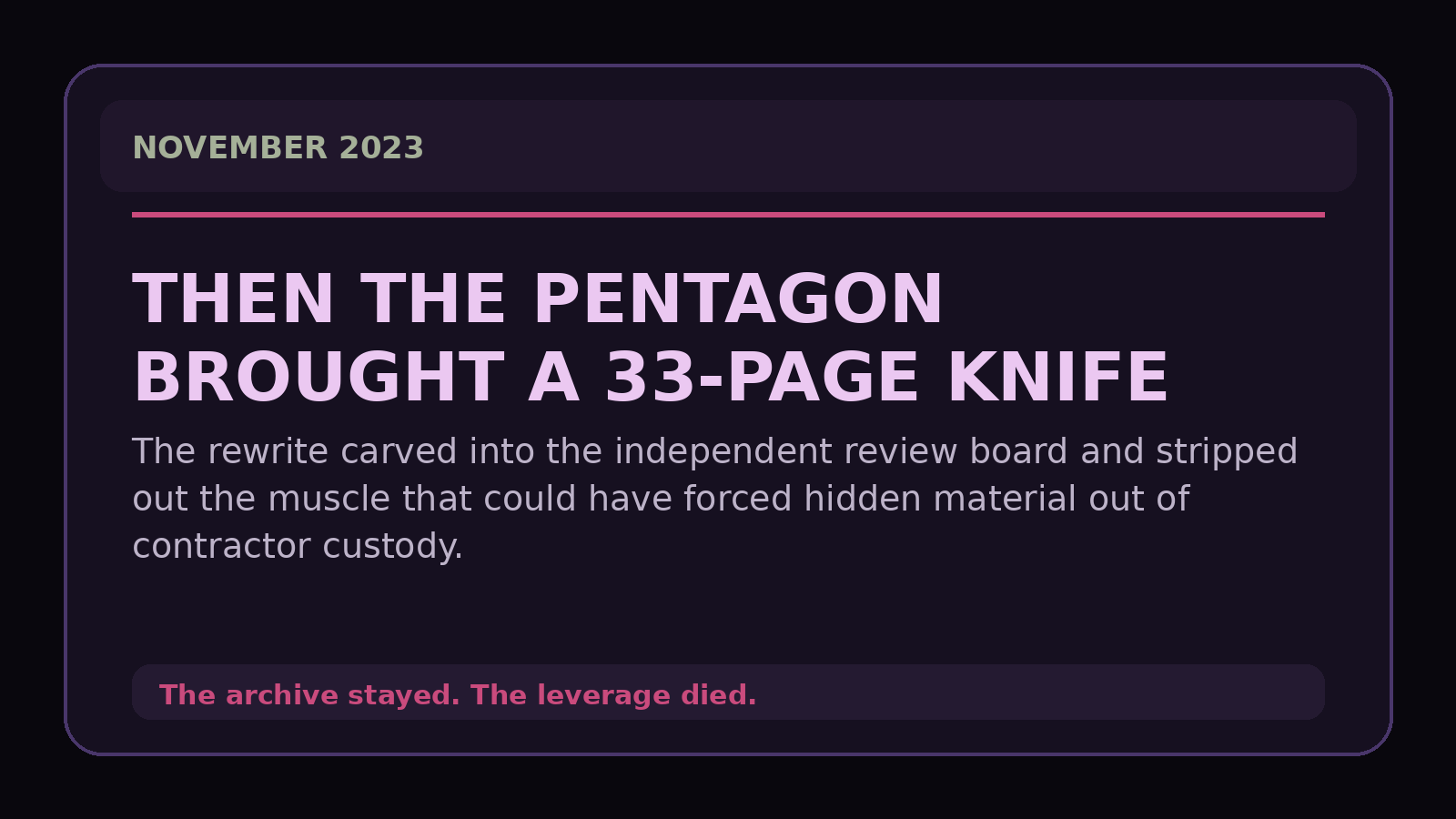
Section 10 of Senate Amendment 797 did not dance around the implication. It used eminent domain, the same brutal little legal crowbar the government uses to take land for roads and bases, and aimed it at “recovered technologies of unknown origin” and “biological evidence of non-human intelligence.” If those words mean what words mean, the Senate was acting on the premise that something extraordinary existed and that at least some of it was not sitting safely inside a normal government filing room.
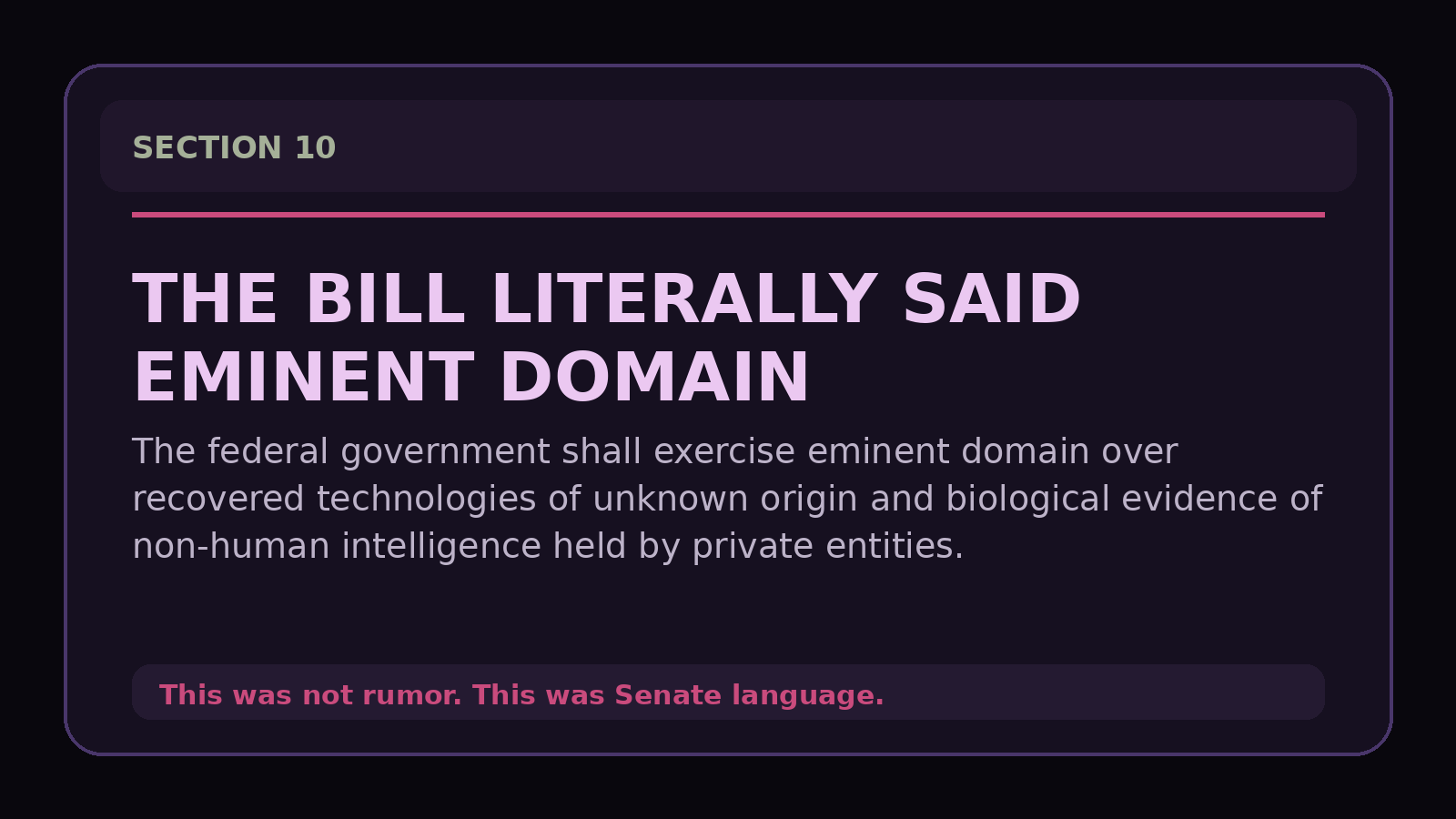
Then came the conference process, which is where transparency goes to get its wallet removed. According to multiple accounts of the negotiation, the Office of the Under Secretary of Defense for Intelligence and Security delivered a 33-page line-by-line rewrite. That rewrite carved out the very parts that would have mattered most: the independent review board and the government’s ability to seize whatever private entities were allegedly holding.
So the public version of the story became softer. The archive survived. The crowbar vanished. And Chuck Schumer, not exactly a man known for writing fever-swamp fan fiction into federal law, later said a cadre of congressional representatives acting on behalf of defense contractors and elements of the intelligence community had blocked the stronger version. That is not disclosure. That is a televised institutional mugging.
Why this matters
The official line on UFOs has always depended on a very specific emotional arrangement. You are supposed to feel silly for asking questions before you get to the documents that make the questions unavoidable.
But once the Senate Majority Leader publicly co-sponsors a law designed to repossess non-human technology from private hands, the burden shifts. The absurdity no longer belongs to the people asking whether something is hidden. The absurdity belongs to the state apparatus that wants to write those words into law while also maintaining that none of this is serious enough to discuss without a smirk.
Imagine Congress writing a law to audit the banks, then letting the banks redline the final text. Imagine Congress writing a law to seize illegally withheld nuclear material, then letting the contractors accused of holding it help neuter the seizure power. That is the shape here. Only the noun is stranger. The power dynamic is not.
What died in November 2023 was not just a clause. It was the first visible admission that the real fight might not be government versus rumor. It might be elected oversight versus a private black-budget ecosystem that has grown so comfortable inside secrecy it now behaves like a parallel state with better lobbyists.
What the record shows
- Senate Amendment 797, 118th Congress contained a direct eminent-domain provision over recovered technologies of unknown origin and biological evidence of non-human intelligence controlled by private entities.
- David Grusch’s July 26, 2023 testimony placed a multi-decade crash retrieval and reverse-engineering program into the Congressional bloodstream under oath.
- Schumer’s public statements after the gutting accused a network of interests linked to defense contractors and intelligence elements of crippling the stronger bill.
- The Pentagon’s November 2023 rewrite reportedly targeted the bill’s enforcement mechanisms, not just its formatting.
- Luis Elizondo’s November 13, 2024 testimony argued that advanced technologies not made by the United States or any known foreign government are monitoring sensitive sites and that the United States possesses some of those technologies.
- Immaculate Constellation was denied by the Pentagon while still being entered into the Congressional Record and associated with a DNI FOIA case number.
- Project 1794 proves the Air Force was willing to fund flying-saucer-shaped high-performance aerospace concepts decades ago while later acting as though saucer talk belonged exclusively to drunks and parking-lot philosophers.
The most corrosive detail is the contractor logic. Eminent domain only makes sense if the government believes someone outside the government has custody. You do not use eminent domain against your own sock drawer. You use it when something exists, someone else has it, and you want legal authority to take it back.
That is why the original bill is so explosive. Even if you think every witness is wrong, the legislative structure itself reveals what at least some highly placed senators had been briefed to consider plausible. A government does not spontaneously draft alien repossession language as a joke. Not at that altitude. Not with that staffing. Not with that legal specificity.
Why this changes everything
For the official story to survive intact, you have to believe a stack of increasingly ridiculous things all at once. You have to believe Schumer and Rounds wrote the language as theater. You have to believe Rubio and Gillibrand signed onto it without understanding what it implied. You have to believe Grusch was either lying or catastrophically duped under oath. You have to believe Elizondo was doing the same a year later. You have to believe the Pentagon just happened to mutilate precisely the provisions that would have forced private custodians to produce the goods.
That is a lot of synchronized innocence. It is almost poetic. It is also harder to believe than the darker, simpler possibility: something significant is being withheld, some of it may sit in contractor space rather than ordinary public custody, and the people who tried to build a legal path into that vault got rolled.
That is why this story is bigger than disclosure fandom. It is not just about whether a craft exists. It is about who gets to overrule Congress when Congress stumbles too close to whatever the classified core really is. A democratic state is supposed to be able to audit its own secrets. When it cannot, the secrecy has escaped the container.
The pattern hardens
Look at the architecture, not the mascot. That is where the pattern reveals itself.
1947, formal investigation begins. 1969, the public program ends but the archive survives. 1988, suspicious papers surface and the state labels them fake without chasing the hand that supposedly forged them. 2001, Project 1794 is declassified. 2012, the already-declassified records are finally released. 2017, AATIP is revealed after years of denial. 2023, Grusch testifies and Schumer drops the bill. 2023, the Pentagon arrives with the rewrite. 2024, Elizondo testifies, Immaculate Constellation enters the record, and the denial machine keeps doing its little jazz hands.
Same motion every time. Public curiosity approaches the locked room. An institution says nothing meaningful is inside. Then documents emerge proving the institution had more knowledge than it admitted. Then the enforcement mechanism gets delayed, softened, archived, laughed at, or rewritten. The ratchet only turns one direction: toward the next managed non-answer.
And yes, the contractor angle is the snake in the wallpaper here. Because once you admit the bill was written against private possession, the entire scandal stops being a campfire story about saucers and becomes a cartel story. Now it is about procurement, classified access, capture of oversight, and whether a handful of firms have become the preferred mausoleums for material Congress itself cannot easily touch. That version is less fun. It is also much more American.
What survived
The documents survived. That is the state’s recurring mistake. It cannot stop writing things down.
The original UAP Disclosure Act language still exists. Grusch’s testimony still exists. Schumer’s public outrage at the gutting still exists. Elizondo’s written statement still exists. Immaculate Constellation still sits in the Congressional Record whether the Pentagon likes it or not. Project 1794 still proves someone in the Cold War was willing to fund a saucer that sounded like science fiction and then file it under normal government paperwork. The Majestic-12 file still sits in the FBI Vault with all its strange little evasions intact.
That is the real shape of this thing. Not little green men waving from a hangar. Not cable-news believers begging to be mocked. A legal struggle over custody. A political struggle over access. A bureaucratic struggle over who gets to know what the government already knows.
The Senate Majority Leader tried to take the keys back. The Pentagon said no. And in a healthier country, that would have been the scandal that swallowed the year whole. Instead it was another Tuesday in the empire of compartmented silence.
Sources
- Senate Amendment 797 to S. 2226, 118th Congress, UAP Disclosure Act of 2023, Congressional Record
S2953-S2959, July 13, 2023 - Senate Amendment 2610 to S. 4638, 118th Congress, UAP Disclosure Act of 2024 revised text
- Schumer-Rounds press release, “Schumer, Rounds Introduce New Legislation To Declassify Government Records Related To Unidentified Anomalous Phenomena,” July 13, 2023
- House Oversight Subcommittee hearing, Unidentified Anomalous Phenomena: Implications on National Security, Public Safety, and Government Transparency, July 26, 2023
- David Grusch sworn testimony and hearing video/transcript, July 26, 2023
- House Oversight hearing, Unidentified Anomalous Phenomena: Exposing the Truth, November 13, 2024
- Luis Elizondo written testimony,
HHRG-118-GO12-Wstate-ElizondoL-20241113.pdf - Michael Shellenberger whistleblower report on “Immaculate Constellation,” entered into the Congressional Record November 13, 2024
- ODNI FOIA case reference
DF-2025-00021associated with Immaculate Constellation materials - Project 1794 Final Development Summary Report, National Archives ARC ID
6920770 - Air Force Declassification Office Article
459834, Project 1794 documents - Air Force Declassification Office Fact Sheet Article
459832, Project Blue Book records - FBI Vault, Majestic-12 collection
- Emma Best, MuckRock reporting on the FBI Majestic-12 file, June 5, 2017
- National Archives, National Declassification Center release list, April 11, 2024
- Inside Government Contracts, “Implications of the Unidentified Anomalous Phenomena (UAP) Amendment in the 2024 National Defense Authorization Act,” January 9, 2024
- Roswell Daily Record, column on the Pentagon’s 33-page rewrite of the UAP amendment, July 28, 2024
- Unknown Country, “Detours on the Road to Disclosure: UAP Amendment Knocked Down,” December 19, 2023